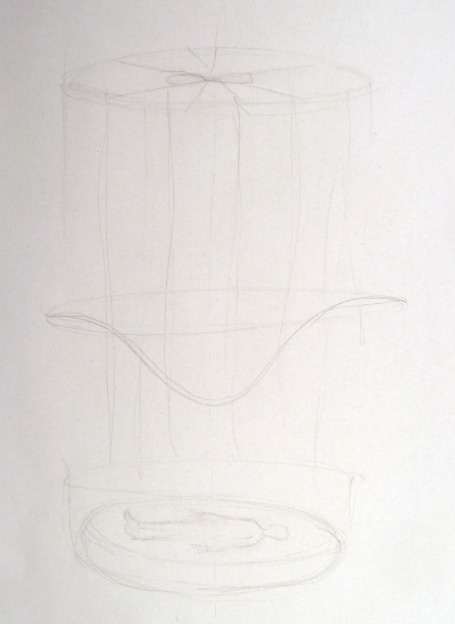
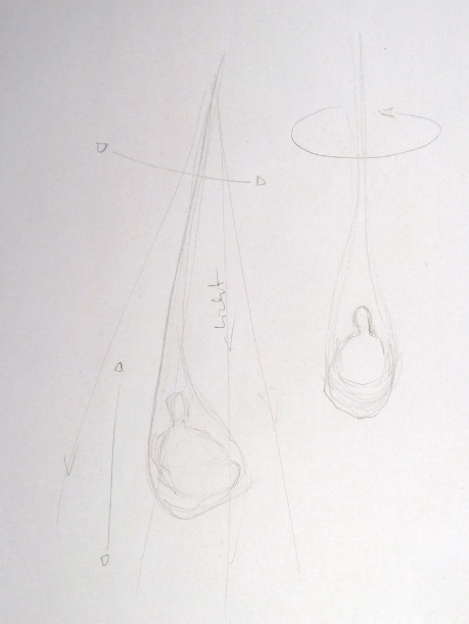
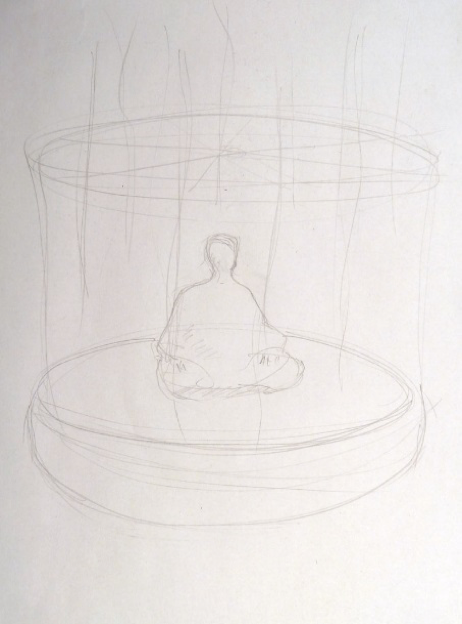
We had the opportunity to use a biofeedback chest belt from a media art project to immediately start interactive experimentation, but had to improve it by making it wireless and by adding an acceleration sensor for motion detection. Experiments with different types of actuators, their parameter settings and compositions, as much as textile material tests, slowly led to a physical immersive evaluation setting. We also opened a pinterest image collection that revealed a community and even an unnamed kind of genre for the concepts, aesthetics and structures of the installation we had in mind. Stepwise we built a large environment of about 4 meters of width, 8 meters in length and 5m of height. It is composed from a single type of white, semi-transparent, non-woven textile with interesting texture and tactility, hanging loosely from the ceiling shaping a cocoon-like isolated space resembling organic natural structures. The resulting very reduced setting is instrumented with spatial, parametrically controlled light (brightness, color, duration, number, spatial composition), sound (type, volume, position, duration) and air stream (intensity, duration, position, direction).
Accelerometers as motion sensors, an elastic respiratory sensor and a photoplethysmograph (measuring heart rate) are used as input modalities. By mapping the visitor’s bio-physiological signals to the ambient parameters, the environment becomes responsive and attaches the visitor to the spatial surroundings and vice versa. Since the atmosphere of the installation changes in real-time according to the physiological reactions of the participants, it is non-linear and does not follow a defined choreography.
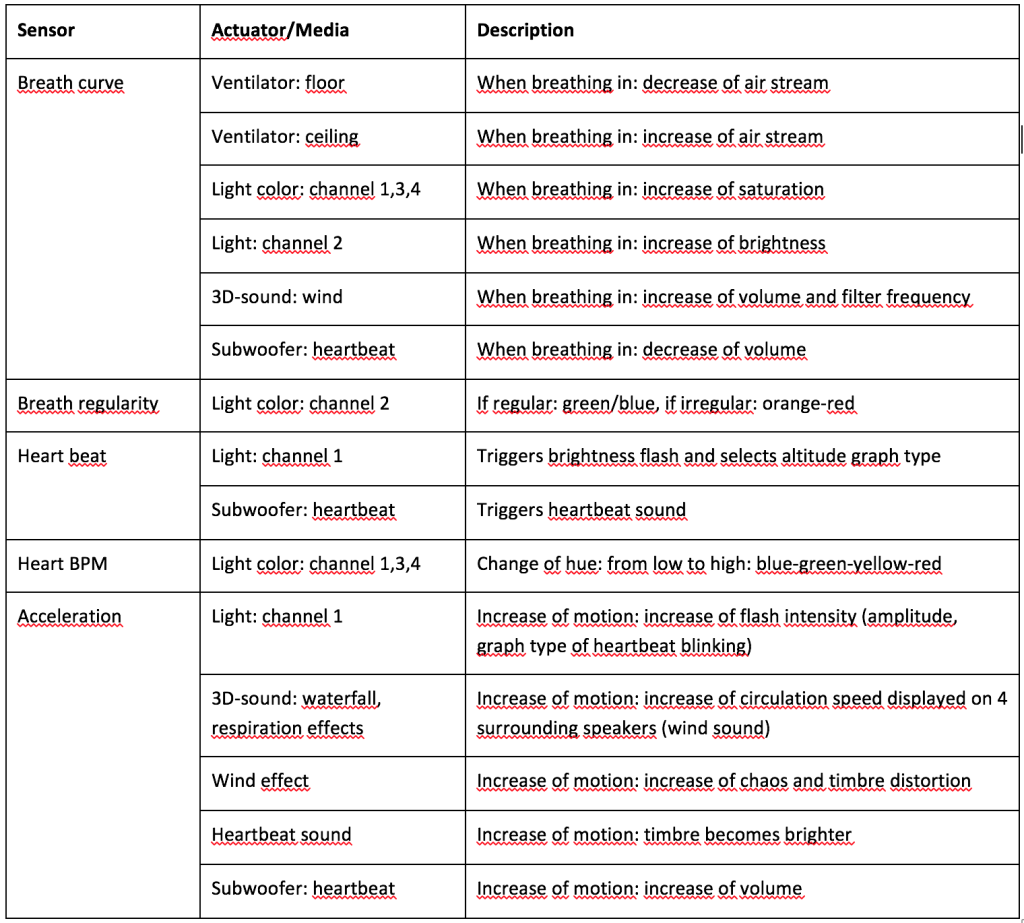
The table on the right gives an overview of the fully controllable sensor-actuator mapping design of the installation. Different types of information can be processed and interpreted from one single biofeedback signal and different parameters of different actuators can change accordingly. To create an atmosphere that can be perceived as emotionally responsive, we developed a complex setting of composed couplings departing from metaphors of the physical world, western media literacy or studies as for example color psychology.